When Silent Films Learned to Put Words on Screen
Discover how silent-film intertitles developed from practical aids into expressive tools, and learn to read their wording, placement and rhythm on screen.
When did silent films begin putting words on screen, and why did those cards become part of the drama? Intertitles appeared as cinema developed from short, largely self-explanatory scenes into longer stories that needed dialogue, context and changes of time or place made clear.
Early title cards
There was no single moment when every filmmaker adopted intertitles. Early practice varied by country, company, genre and period: some films relied on images and gestures, while others used cards to clarify action or identify a scene. As films grew more complex, printed words became a familiar way to carry information that pictures alone might leave uncertain.
Intertitles were inserted between moving images, often on their own cards. They could identify a location, explain a jump in time, present a letter or give a character’s line. Their form and frequency changed over cinema’s silent era; a film’s cards were not simply a standard transcript of everything its characters might have said.
Dialogue and action
Some intertitles presented dialogue, but filmmakers did not need to print every exchange. A short line could establish a question or intention, while a look, gesture or movement supplied the tone and response. The balance between words and images varied from film to film.
Imagine a fictional scene in which a shopkeeper notices a customer leaving a purse behind. If the card “You forgot this” appears before the shopkeeper reaches for it, the words frame the action as an intention; if the card follows the customer’s turn away, it can read as a private aside. The placement changes the viewer’s impression of who is being addressed, even though the wording stays the same.
Information and point of view
Cards could orient viewers with a place or time, provide a letter’s contents, or supply context that would be cumbersome to stage. A film might show a letter before presenting its words, connecting the card to an object in the scene; a more general title could speak from outside the characters’ immediate experience.
Look at the shots around each card. A character shown just before it, a letter held in someone’s hands, or a reaction afterwards can help identify whose words they are. Typography and framing may offer clues, too, but the sequence of images often does the clearest work.
Timing and emphasis
Every intertitle interrupts the moving image so the viewer can read. A brief line may make a clipped beat; a longer passage can hold attention away from the actors. Notice whether the film resumes with continuing action, a change of direction or a reaction to the words.
A card can also shape a joke, delay a reveal or make a response feel pointed. If the words seem to repeat what the image already shows, ask whether their timing changes the mood or directs attention to a detail. Sometimes the apparent pause is the point.
Reading intertitles?
When did silent films start using intertitles?
Intertitles emerged during the early development of cinema, but their use was not uniform or instantaneous. As films became longer and their stories more involved, title cards became a useful way to present dialogue and clarify information.
Did intertitles always show dialogue?
No. Depending on the film, a card might give a character’s line, identify a place, mark elapsed time or supply other context. Some scenes rely mainly on performance and action rather than printed conversation.
How are intertitles different from subtitles?
Intertitles are cards inserted into the film, while subtitles usually appear over an image. In a silent film, an intertitle may present dialogue itself; a subtitle more commonly represents speech that can also be heard.
What if a card feels unnecessary?
Compare it with the action before and after. If it repeats visible information, check whether its wording or placement still changes the tone; if it adds no clear change, treat that as a clue about the film’s pacing or its intended audience.
A five-session viewing plan
Choose one silent film available from a film archive, library collection or reputable streaming service, and use a notebook to track the cards. Keep each session focused on a different question rather than trying to catalogue everything at once.
- Session one: Watch without pausing and mark each card’s position; if a card interrupts an action, note what is left unfinished, then check whether the next shot resumes it or shifts elsewhere.
- Session two: Label each card as dialogue, explanation, time or place, or emphasis; if a card fits more than one label, record both, then keep its role open for later viewing.
- Session three: Write down what appears immediately before and after each card; if a reaction follows, consider whether it answers or complicates the words, then compare it with any card followed by action instead.
- Session four: Compare short cards with longer passages; if a longer passage delays the story, note what the film does when the image returns, then distinguish a deliberate pause from a simple transfer of information.
- Session five: Choose one card whose position seems consequential and describe the surrounding scene without relying on its wording; if the action still makes sense, note what the card adds, then compare that with what would be lost if the card were absent.
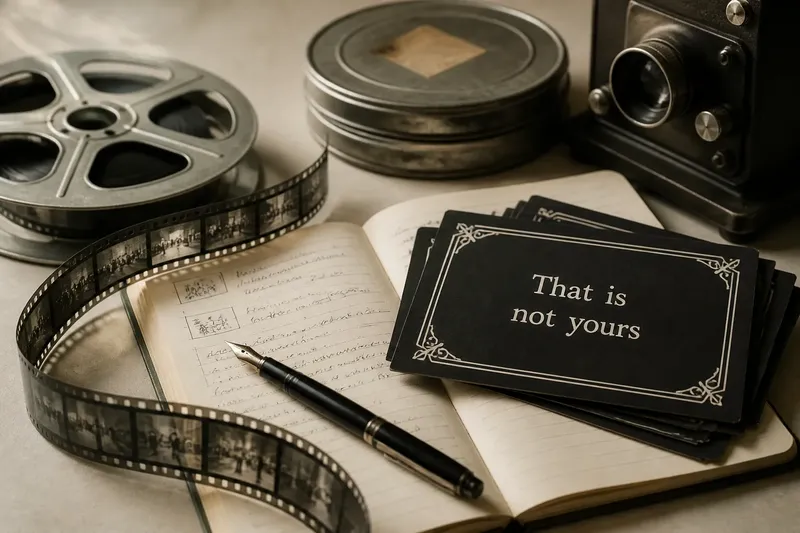
For a fully worked invented case, imagine the selected film is a fictional comedy in which a guest reaches for a hat that belongs to someone else. In session one, you mark the card “That is not yours” between the reach and the owner’s reaction; in session two, you label it dialogue and emphasis; in session three, you note that the owner’s raised eyebrow follows it. In session four, you observe that the short card creates a pause before the reaction, and in session five you write that the scene remains understandable without the words, but the card makes the guest’s mistake explicit before the eyebrow turns it into a joke. Your resulting reading is that the card does more than explain: its position sets up the comic reaction.
If a card vanishes before you can read it, pause the player or use its controls rather than guessing. If the version uses translated or newly prepared titles, note that wording may differ from an earlier presentation; the relationship between card and image can still be examined.
Words between images
To understand when silent films learned to put words on screen, look beyond the date of an individual card and consider what it does in its film. Intertitles developed as flexible tools for dialogue, orientation and emphasis, with their use shaped by each film’s needs.
When you next watch a silent film, notice the moment the image stops, the words take over and the scene begins again. That interval can tell you not only what the story needs you to know, but how the filmmaker wants you to feel about what happens next.