The Doorway Before the Cut: How Entrances Set a Scene in Motion
A doorway entrance can clarify a room, direct attention and build tension before the first cut, helping viewers follow the action without losing its mystery.
How can a doorway entrance make a scene feel clear before the camera cuts? A doorway entrance can show where the characters are, what they want and which detail matters, all within the same view. The threshold is not merely a route into the room; it can organise the scene’s action.
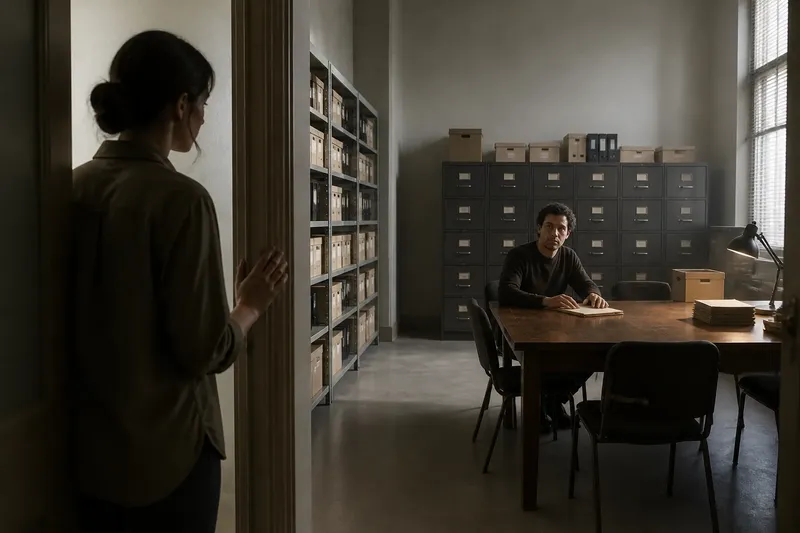
Imagine a hypothetical scene in which Mara, a junior archivist, enters a records room to retrieve a folder before her supervisor arrives. Her colleague Ivo sits at a table with the folder beneath his hand. The director wants viewers to understand the room, notice Ivo and sense Mara’s awkward arrival without explaining any of it in dialogue.
The entrance works as a small piece of blocking: it lets the audience read the relationship before an edit reshapes the space. The camera, doorway and actors need to reveal useful information in a deliberate order.
Map the room
Start with the spatial facts the audience needs. In the imagined records room, the doorway sits at one end, the table occupies the centre and a tall filing cabinet stands along the far wall. A camera view that includes these landmarks gives viewers a basic map before Mara moves.
That map matters more than a catalogue of furniture. It shows the route from the entrance to the folder, the distance Ivo can use to guard it and the open floor Mara must cross. A doorway at the edge of the frame can also suggest that the room continues beyond the image.
Choose a camera position that preserves those relationships. A view from inside the room, angled towards the door and table, could show Mara arriving while Ivo remains still. The frame need not reveal every corner; it should show enough for the next movement to make sense.
Before filming, block the actors without dialogue and watch from the intended camera position. Use this concise staging checklist; each observation leads to a clear adjustment:
- Check whether the doorway and table are both visible; if not, move the camera or furniture, or choose a different angle.
- Check whether Mara’s route from the threshold to the table reads clearly; if it does not, clear the path or adjust her starting mark.
- Check whether viewers can locate the folder; if it is hidden unintentionally, reposition it or change the camera angle.
- Check whether Ivo’s hand appears to cover the folder deliberately; if the gesture is unclear, alter his hand placement or body orientation.
- Check whether Mara’s movement is distinguishable from Ivo’s stillness; if both compete for attention, hold one actor’s movement until the other action registers.
- Check whether the actors’ eyelines point towards the intended landmarks; if they do not, adjust their marks or sightlines before adding a close view.
Make thresholds matter
A character’s first movement can pose the scene’s first question. Mara might reach the doorway and pause with one hand on the frame. That beat lets viewers register the room and turns crossing from routine movement into a decision.
The frame can support the choice without overemphasising it. Mara’s hand on the jamb makes contact with the boundary; her glance towards the table points to the folder; her shift of weight suggests she has not committed to crossing. These cues should not all compete for emphasis at once.
In the imagined scene, Mara stops at the threshold, spots Ivo’s hand over the folder and steps in only after he looks up. Viewers can follow entrance, obstacle and response because each action changes the meaning of the next. The doorway gives her hesitation a place to happen.
Actors can make the beat legible through timing and orientation. Mara might keep one shoulder turned towards the corridor while looking at Ivo, leaving a route back open; Ivo might stay square to the table, claiming the space around the folder. Small, playable choices can establish a relationship more clearly than broad gestures.
Guide the viewer’s eye
The audience cannot look at every part of a frame at once, so the entrance should guide attention rather than scatter it. A bright doorway behind Mara may initially draw the eye to her silhouette. As she moves away, the table and Ivo’s hand can become more prominent.
Blocking, contrast and stillness can share this work. If Ivo remains motionless while Mara crosses the room, his stillness may make him stand out. If both actors move at once, viewers may not know whether to follow Mara’s approach or Ivo’s reaction. A brief hold gives the eye somewhere to land.
A look can also act as a quiet cue. Mara’s gaze drops towards the folder; Ivo’s hand tightens over it. That response makes the object a point of attention with a story attached: he knows what she wants and may be stopping her from taking it.
In this invented scene, viewers can understand the practical arrangement—the door, the table and the guarded folder—while remaining curious about Ivo’s motive. Clear geography leaves room for suspense because the uncertainty concerns motive, not basic orientation.
Keep movement readable
Once Mara leaves the doorway, her path should remain easy to follow. If she walks diagonally towards the table, the camera should show enough of the route to connect her starting point with her destination. A chair or cabinet can interrupt the path deliberately, but it should not make viewers lose track of her position.
Changes of direction need particular care. If Mara begins by moving towards the camera and then turns across the room, her shoulders, feet and eyeline can clarify the pivot. Viewers use those cues to follow her, especially when the set offers several possible routes.
Mara might take one step towards the table, then stop when Ivo moves the folder out of reach. The interruption gives the actors a clear cause-and-effect exchange: her movement tests a boundary, and his movement redraws it.
Distance can create tension without making the room confusing. Keep the landmarks stable as the actors move, and let their changing positions supply new information. Mara has entered Ivo’s territory; he has answered her approach.
When should the camera cut?
What should viewers know before a cut?
They should understand the spatial facts needed for the next beat: where the doorway is, where the important object sits and how the characters relate to it. A complete floor plan is unnecessary; the audience needs enough orientation to follow the action.
Can an entrance work without a pause?
Yes. A brisk entrance can establish urgency if the route and destination are immediately readable. The pause in Mara’s scene serves its particular tension; not every character needs to hesitate at a threshold.
When does a doorway distract?
A doorway distracts when its shape, light or activity pulls attention away from the action without adding meaning. If a bright corridor overwhelms Ivo and the folder, try another camera angle, adjust the lighting or simplify the background.
What if the room will not fit in one frame?
Show the most important landmarks first, then preserve their relationships as the scene continues. A second angle can add information, but viewers should be able to connect it to the first through consistent screen direction, eyelines or a recognisable feature of the set.
Let cuts change meaning
Once the entrance has established the room, a cut can narrow attention without sacrificing orientation. The camera might move from the wider view to Mara’s glance at the folder, then to Ivo’s hand covering it. Because viewers already know where those details sit, the tighter views feel like emphasis rather than an unexplained new space.
Editing can also hold back a reaction until it matters. Suppose Mara reaches the near side of the table and asks for the folder; the scene could cut to Ivo only after his hand shifts. The gesture motivates the change of view and marks a new development in the action.
A cut before Mara crosses the threshold could leave viewers uncertain about the room’s layout, which may be useful if disorientation is intended. For this scene, though, that choice would weaken the practical tension: the audience needs to see the distance she must cross and the object she is trying to reach.
Plan for the edit while staging the entrance, even if the opening remains unbroken. Mark where a closer view could begin, what action motivates it and whether the cut preserves direction. This gives the editor options without asking a later shot to invent a relationship the blocking never established.
What the scene earns
In the imagined scene, Mara’s entry begins as a route into a records room and becomes a visible negotiation. The doorway marks her hesitation, the table gives Ivo something to protect, and their movement across the floor reveals who controls the encounter. By the time the camera cuts closer, viewers can read both the room and the conflict.
Treat the threshold as part of the scene’s action. Map the essential landmarks, give the entrance a readable purpose and let movement direct attention towards the details that matter. When the first cut arrives, it can sharpen the story rather than explain where everyone is.