The Background Music Is Not a Mood Button
Background music does not dictate one emotion: learn how timing, scene action and attention change a cue’s meaning, and hear what the score asks you to notice.
Why can the same swell of strings feel tender in one scene and ominous in another? Background music changes meaning through timing, action and what the viewer notices; listen for those relationships and a cue becomes part of the scene’s drama, not merely an emotional label.
Three listening routes
A cue can align with the action, work against it or arrive at a revealing moment. These are not rigid categories: one passage might begin in step with a character, then turn unsettling as the scene changes.
The same musical gesture can also land differently depending on where you look. A viewer watching a character’s face may hear intimacy; someone tracking a threat in the background may hear warning. The question is not only what the music sounds like, but what the scene has taught us to notice.
Music and action
When music moves in sympathy with a scene, its rhythm, shape or texture may reinforce what is happening. A rising phrase during a character’s hesitation can make the pause feel charged; a gentle melody beneath a reunion can invite warmth. Alignment, though, is not a fixed emotional instruction.
Watch the image closely. If a character smiles while a minor-sounding harmony hangs beneath the moment, the cue might complicate the smile rather than simply darken it. The performance, surrounding silence and what came before all help determine whether the music feels affectionate, uneasy or both.
This approach can support a clear emotional current while leaving room for an actor’s expression or a small visual detail to alter the tone. The cue may guide attention, but the image can redirect it.
Music against the image
A contrasting cue creates a gap between what we see and hear. Bright music over troubling action can produce unease, irony or distance; a solemn score beneath a mundane task may make it feel unexpectedly consequential. The contrast need not be loud or obvious.
Context decides whether the mismatch feels playful, disturbing or strange. If a scene establishes a character’s cheerful self-deception, jaunty music may reflect that character’s view while the image lets us see the danger. Without such a clue, the same music might sound like a wry comment from outside the story.
Contrasting music can invite viewers to question a scene’s surface or hold two reactions at once. Notice whether the cue sharpens the tension or distracts from subtle acting.
Music at turning points
Sometimes the decisive choice is not a cue’s style but its entrance or exit. Music that begins after a character makes a choice can make that choice feel newly significant; a cue cut off just before an answer can leave the silence carrying the suspense. A phrase continuing across a change of location may connect scenes that otherwise seem separate.
Track the precise moment the cue appears. Does it begin before the audience understands the danger, as a hint? Does it wait until a character looks away, making the music seem tied to an inner thought? A delayed entrance can change the apparent source of emotion: the scene may seem to create the feeling, or the character to reveal what was already there.
When a cue feels familiar or emotionally obvious, its placement may be doing more interpretive work than its melody. Notice what happens just before the first note and what changes when the last one disappears.
Questions for listening?
Does the cue begin before or after the action?
A cue that precedes an event can prepare you to expect trouble or tenderness, while one that follows may colour your response afterwards. Compare the first audible note with a character’s movement, look or decision.
Does the music agree with the performance?
Notice whether the score supports the actor’s expression or pulls it elsewhere. A restrained face under an expansive melody may suggest hidden feeling, though it could also make the music feel imposed rather than intimate.
What holds your attention?
Try watching the foreground action, then the edges of the frame, without assuming either is the intended focus. If the cue’s meaning shifts with your attention, the scene may use music to connect details the image leaves apart.
What changes when the music stops?
The end of a cue can expose room tone, dialogue or a small physical sound that had been masked. Notice whether the scene feels more exposed, ordinary or tense once the score withdraws.
A focused rewatch
On a first viewing, follow the scene rather than trying to decode every instrument. Ask whether the cue aligns with the action, contrasts with it or marks a turn, then check whether the acting and events support that impression. This keeps the soundtrack connected to the drama.
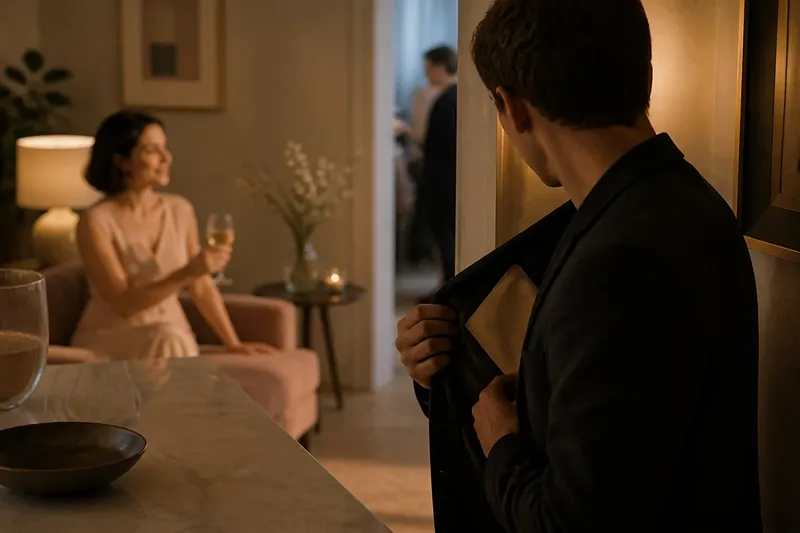
Say you rewatch an invented scene in which a guest smiles while another person quietly hides a letter. First, listen while watching the guest: a soft piano cue might seem welcoming. Next, watch the hidden letter and note when the piano begins; if it starts as the letter disappears, the cue may feel uneasy. The resulting shift is a different reading of the same passage, not proof of one correct emotion.
For a comparison between films, look at how each handles a similar dramatic moment rather than ranking one cue as more emotional. One might let music rise with a confession; another might hold back until the listener sees the other character’s reaction. That contrast reveals whose experience each scene asks us to share.
Context and meaning
Background music’s meaning is made in company: image, performance, timing and attention all take part. When a cue seems to dictate a feeling, shift your attention or notice its entrance and exit. Ask what the music makes you notice at that moment.
That question leaves room for more than one reading without pretending every interpretation fits equally well. A cue can guide, mislead or complicate, and the scene offers clues for deciding which is happening. Listen at the moment the music meets an action; the interaction, not mood alone, carries the meaning.